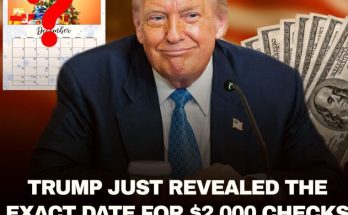
Trump’s declaration landed with the force of a detonator: a promise that $2,000 checks would hit Americans’ hands by Christmas. One line from a rally stage, and suddenly the country lit up. People grabbed calculators, imagined cleared balances, pictured relief arriving just in time for the most expensive month of the year. But excitement quickly collided with confusion, and confusion turned into suspicion. Because behind the bold promise sat a brutal truth—none of the machinery needed to make these payments real actually exists.
Trump delivered the announcement with absolute confidence, fusing political instinct with theatrics. He knows exactly how the idea of instant cash plays in a country exhausted by high prices, rising debt, and relentless financial pressure. The promise hit people where they feel everything: the wallet, the kitchen table, the grocery line, the gas station. It didn’t matter whether anyone understood tariffs or federal revenue or legislative timelines. What mattered was the image—money, fast, during the holidays.
But that image sits on top of a chasm. A gap between what was said and what is currently possible.
The entire concept depends on tariff revenue, a pool of money that fluctuates with trade disputes, global market shifts, and presidential decisions. It’s not a predictable fund. It’s not sitting in a vault waiting to be distributed. And it’s not nearly as large as the promise implies. On top of that, no legislation has been introduced to authorize payments. No rules exist for eligibility. No infrastructure is being built. The federal agencies needed to implement such a massive payout have said nothing. Without Congressional approval, a presidential statement is just noise.
Still, the message traveled far because it was crafted to bypass logic. It wasn’t pitched as policy. It was pitched as hope. And hope, especially in a country as financially stressed as this one, spreads fast.
Trump’s rollout flattened nuance into something irresistible: Christmas money, courtesy of tariffs. But for every family imagining a brief financial breather, there’s an unavoidable reality—Washington isn’t aligned behind this. Not even remotely. Congress hasn’t seen a bill, analysts haven’t seen a framework, and the IRS hasn’t seen instructions. Without all three, nothing moves. Nothing gets printed. Nothing gets deposited.
Yet the promise keeps echoing, because it taps into something deeper than economics. It exposes how desperate Americans are for relief, how fed up they are with rising costs, and how easily a big promise can overshadow the hard mechanics behind it. Trump knows his audience, and he knows how to deliver a message that feels like action, even if the action hasn’t been built.
Supporters took the statement as gospel. Critics dismissed it as empty showmanship. But both sides reacted emotionally, which means the message did exactly what it was designed to do. It didn’t matter that tariff revenue is unstable. It didn’t matter that no distribution process exists. It didn’t matter that every expert in Washington responded with raised eyebrows. The purpose wasn’t to inform. It was to electrify.
Behind the scenes, the unanswered questions pile up fast. Who qualifies? Will income be the determining factor? What income limits would apply? Would the payments go out as checks, tax credits, or something else entirely? How would the government verify eligibility? Could agencies even move fast enough to deliver funds by December? Where does the actual money come from when the revenue isn’t there? What happens if tariff revenue drops again?
None of those questions have answers—not even half-answers. There’s no bill to dissect. No outline to analyze. No working group in Congress drafting language. The timeline Trump announced—checks before Christmas—doesn’t line up with how federal policy is created. Passing a spending measure of this scale typically takes months of negotiation, budget scoring, committee hearings, amendments, and political wrangling. Nothing of the sort has begun.
But as flawed as the promise may be, it reflects the emotional temperature of the country. Americans are tired. They’re drained by prices that don’t budge, wages that don’t stretch, jobs that don’t feel secure. A sudden $2,000 injection feels like salvation. Trump understands this better than most politicians. He speaks in shortcuts—quick images, bold promises, hard-hitting sound bites. It’s not policy language. It’s emotional language, and emotional language moves people.
That’s why the $2,000 claim caught fire instantly. It wasn’t a policy announcement—it was a mirror. It reflected back the frustration, the fear, the exhaustion, the longing for relief. When leaders offer relief with a deadline attached—“by Christmas”—people cling to it because they need something to cling to.
Meanwhile, economists and analysts pointed out the obvious: the funds simply aren’t there. Tariff revenue doesn’t cover even a fraction of what nationwide payments would cost. And if tariffs were increased dramatically to generate more money, prices on everyday goods would rise even further, counteracting the benefit of the checks. The math doesn’t hold. The system isn’t ready. The timeline collapses instantly under scrutiny.
But people aren’t craving scrutiny. They’re craving relief.
Trump’s promise reveals a nation so financially stretched that even a hypothetical check becomes headline news. It shows how easily political statements can turn into national discussions, even when no paperwork, no logistics, and no realistic timeline support them. It shows how hungry people are for support that has remained out of reach for years.
Whether these checks ever materialize is another story entirely. Right now, the promise sits in a fog—no clearer, no more concrete, no closer to becoming a real policy. It’s a high-voltage headline crafted for maximum emotional impact, delivered at the perfect moment to catch fire. It leaves Americans stuck between hope and doubt, weighing the possibility of holiday relief against the familiar feeling of political promises evaporating once the applause fades.
For now, the country waits in that gap—uncertain, skeptical, hopeful, and fully aware that the promise may end up being more buzz than reality.